

Replacement
Ceiling replacement across Sydney: out to the joists, then re-sheeted
Taking an existing ceiling right out and lining it again. It is the answer when the board has stopped doing its job, and it is the wrong answer when a repair would still hold.
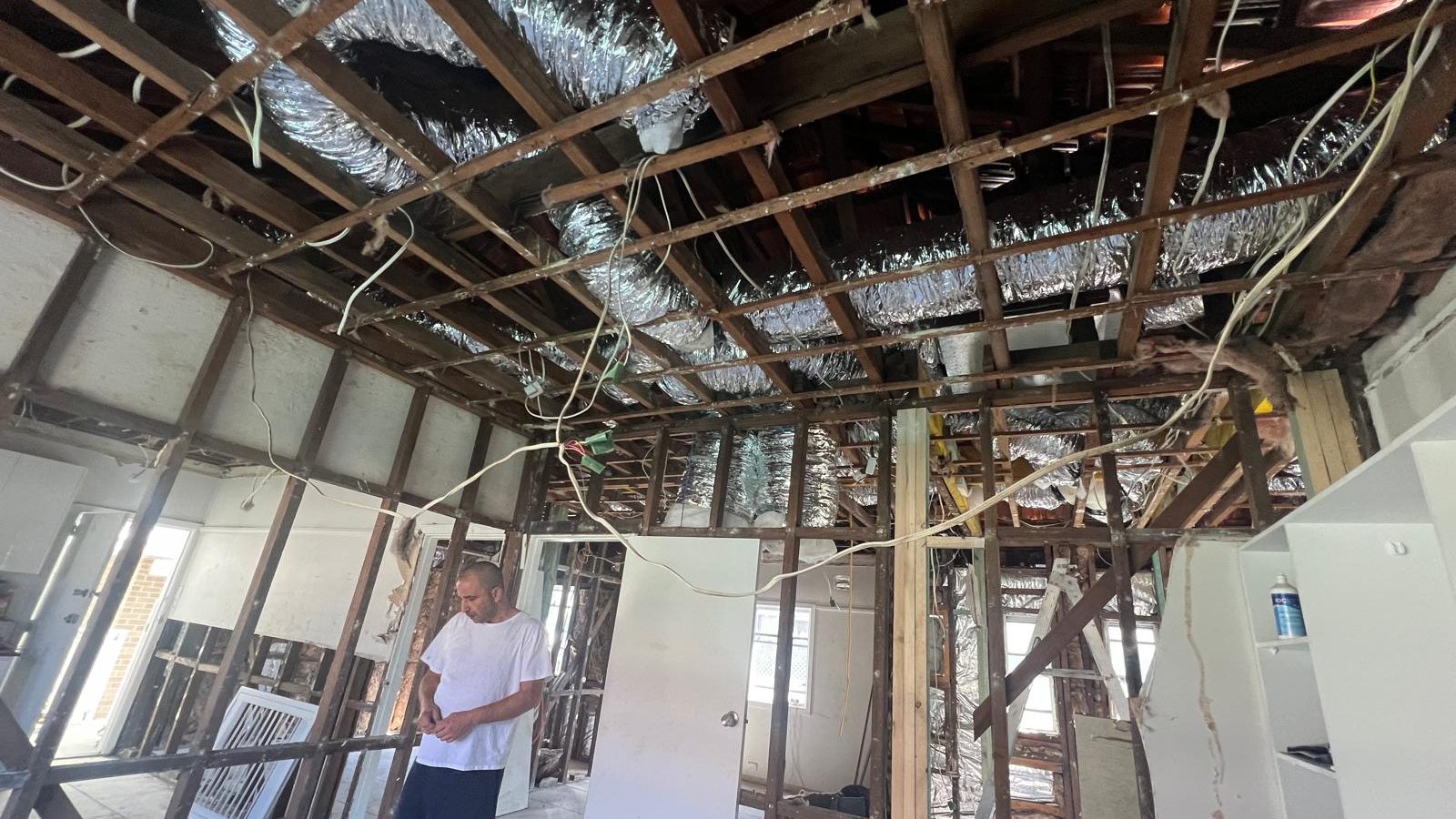
Replacing a ceiling is a bigger, dirtier and more disruptive job than repairing one, and it is worth explaining properly rather than selling. Everything above the ceiling becomes visible and accessible for a few days: the joists, the battens, the wiring, the insulation and whatever the last hundred years put up there. That is both the cost of it and the opportunity in it.
The reason to do it is usually simple. Patch after patch has stopped adding up, or the board has lost its strength and no amount of setting will bring it back. Below is what the work actually involves, how it is sequenced, and where the line sits between repairing and replacing.
- Strip out to the frame
- Battens, wiring and insulation checked
- Cornice and finish reinstated
Replacement is a last answer
If a repair would hold, we will quote the repair. A ceiling that can be saved is cheaper for you and less disruptive.
The frame gets checked
With the board off, the joists, battens and fixing spacing are visible. That is when problems get found rather than covered.
Other trades in the right order
Wiring, fans and ducting are isolated by their trades before the strip out and refitted after the sheeting.
Reinstated, not just sheeted
New board is only half of it. The cornice line, the wall junctions and the finish all have to come back with it.
Is it the right call
When replacement makes sense, and what to settle first
Replacement is right when the board has run out of useful life, and wrong when it is being used to avoid a diagnosis. The left column is the normal case for it. The right column is not a reason to avoid it, only work that belongs in front of it.
Replacement is usually the honest answer
- Board that has been saturated across most of the plane and has lost its strength
- A ceiling that has already been refixed once and has sagged again
- So many separate old patches at different levels that even a full skim would sit on failing board
- Fixings or batten spacing that were never adequate, so the sheet keeps letting go
- A ceiling coming down anyway for new ducting, a bulkhead or a change in ceiling height
Settle these before it is booked
- Any leak, current or intermittent, which has to be stopped and confirmed by a roofer or plumber
- A sheet material you cannot identify. Older ceilings need testing before anything is disturbed
- Structural movement. A sagging beam, split joist or removed wall is a builder or engineer question
- Wiring, downlights, fans and ducting, which an electrician has to isolate before strip out
- Whether a repair would actually do. Ask for that comparison before you commit to a replacement
Scope
What a ceiling replacement takes in
This page covers full removal and re-lining of an existing ceiling. It is a defined plastering scope with clear edges, and the edges matter because a replacement touches more trades than any other plastering job.
Included in the plastering scope
- Protection of floors, openings and anything that cannot be removed from the room
- Controlled removal of the existing ceiling sheets and the fixings left in the frame
- Taking down the existing cornice where it has to come off
- Checking the joists and ceiling battens, and packing or straightening where board cannot be fixed flat
- Setting insulation aside where it can be reused, and removing it where it cannot
- New plasterboard selected for the span and the room, fixed to the frame on a proper pattern
- Back-blocking or supporting butt joints so they do not read as a ridge later
- New cornice run or the existing profile reinstated where it survived
- Joints taped and set in coats, fixings spotted, sanded flat and checked under raking light
- Debris bagged out of the room and removed, and the space left clean
Other trades or other pages
- Any partial repair, patch or refix, which is ceiling repairs or sagging ceilings
- Electrical work. Isolating, removing and refitting lights, fans and cabling is an electrician's
- Testing or removing any material that may contain asbestos, which is licensed work
- Plumbing, roofing and waterproofing repairs that caused the failure in the first place
- A new lowered or framed-down ceiling system, which is suspended ceilings
- A new ceiling in a new or unlined space, which is ceiling installation
- Painting, which is a painter once the ceiling is set and sanded
Where the ceiling is coming out because of water or because it dropped, the cause has to be resolved first. A new ceiling under a live leak is the most expensive way to hide a problem.
What actually happens
What comes down, and what goes back up
People imagine the sheeting. The parts that decide how the job goes are the strip out and what is found in the frame, because that is where a replacement either becomes straightforward or becomes interesting.
Coming down: the sheets, in sections rather than all at once, with the room protected and the debris bagged as it goes. Then every nail and screw left in the joists or battens is pulled, because new board cannot sit flat over old fixings. The cornice usually comes off with it, since a cornice fixed to both wall and ceiling rarely survives the ceiling being removed from under it.
What gets looked at while it is open: whether the battens are straight and at a spacing the new board can be fixed to, whether any joist has twisted or split, whether the insulation is dry and worth keeping, and whether the wiring, ducting and fan housings above the ceiling are where they need to be for what is going back. This is the only time in the life of a house when all of that is visible at once, and it is worth using.
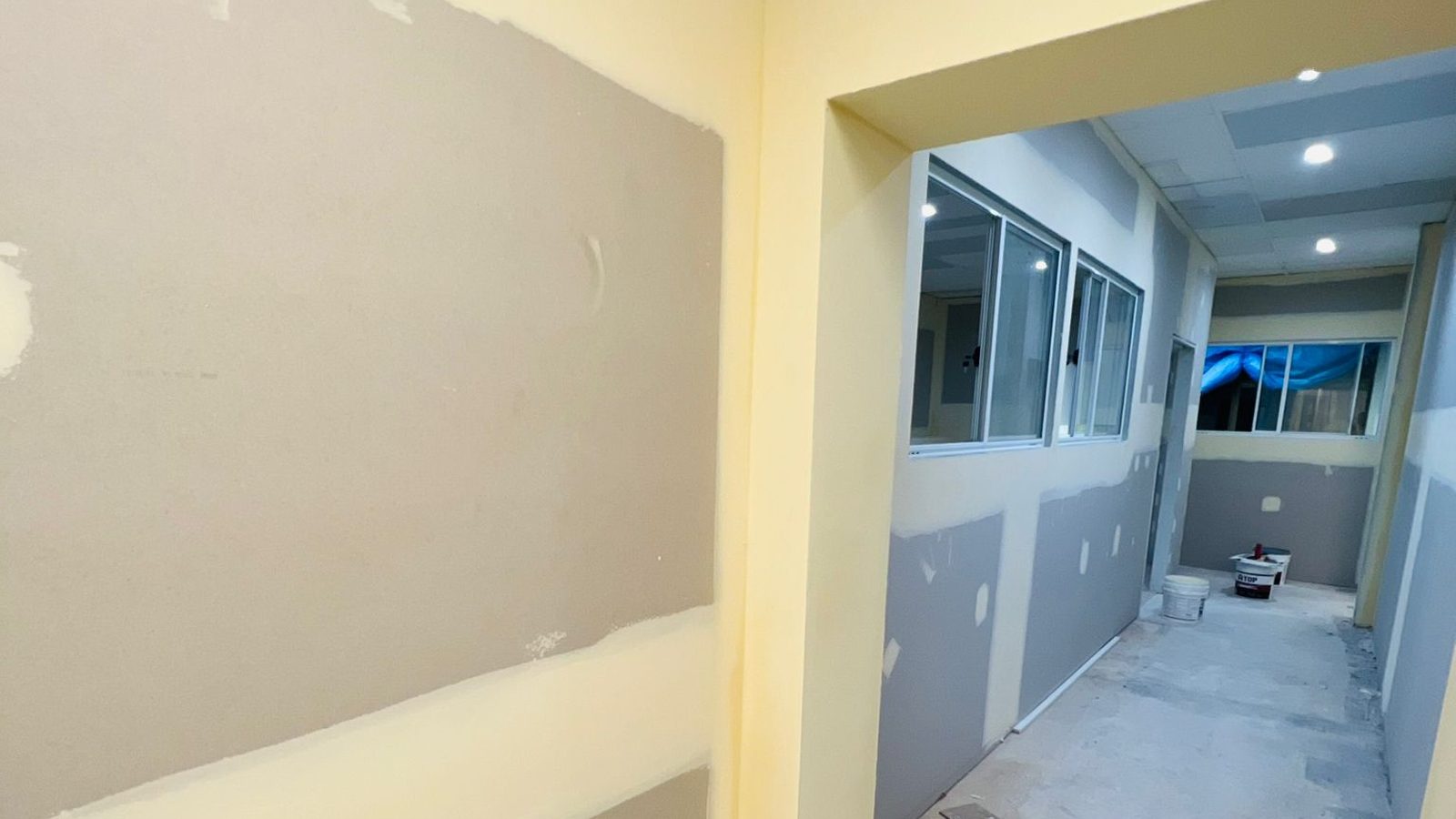
Going back up: board chosen for the span and the room, fixed to the frame on a proper pattern, with butt joints supported so they do not telegraph later. Then the cornice is run, the joints are taped and built up in coats with drying time between them, the fixings are spotted, and the whole plane is sanded and checked with the light running across it before anyone calls it finished.
Sequence
How the days are ordered on a replacement
A single room is usually a week of elapsed time with three or four attended visits inside it. Most of the calendar is drying, and most of the coordination is making sure the electrician comes at the right two moments rather than the wrong one.
- 01
Assessment and scope
On site, with a look above the ceiling where there is access. What board is up there, what the frame is like, what is in the way, how the debris will leave the building, and whether a repair would honestly do instead. The scope is written before anything is booked.
- 02
Other trades booked around it
An electrician to isolate and remove lights and fans before strip out, and to refit after sheeting. A roofer, plumber or waterproofer first if the cause sits with them. On a claim, the scope and photographs are done before anything is touched.
- 03
Protect, then strip out
Floors covered, doorways sealed as far as the layout allows, furniture out or wrapped. Sheets come down in controlled sections, fixings are pulled from the frame, insulation is set aside or bagged, and the debris goes straight out rather than sitting in the room.
- 04
Frame and services checked
Battens checked for line and spacing and packed or replaced where they are out. Any joist problem is reported to you before sheeting rather than after. Fan blocking, light positions and access panel locations are set now, not later.
- 05
Sheet and fix
New board up and fixed to the frame, cut in around services, with joints planned so they fall where they are easiest to hide. Where a butt joint cannot be avoided it is supported behind so it does not show as a ridge once the ceiling is painted.
- 06
Cornice, set, sand and hand over
Cornice run or reinstated, joints taped and topped in coats with drying time between them, fixings spotted, then sanded and checked under raking light. Room cleaned, electrician back for the fittings, ceiling handed over ready to paint.
Strip out Re-line and finish
The comparison
Repair or replace, side by side
Worth doing this arithmetic honestly, because the answer is not always the bigger job. Repair wins more often than replacement does, and the cases where it does not are fairly recognisable.
| The ceiling in front of you | Repair | Replace |
|---|---|---|
| Cracking along the joints, board sound and firm | The right call. Rake, reinforce, re-set | Wasteful. Nothing wrong with the board |
| One sheet dropped, the rest well fixed | Piece in or refix that sheet | Only if the same failure is likely elsewhere |
| Four or five old patches sitting at different levels | A full skim over the plane usually fixes it | Only if the board underneath is also failing |
| Water through most of the ceiling, board soft | Not viable. Soft board holds nothing | The honest answer, once everything is dry |
| Refixed once already and sagging again | A second refix rarely holds | Yes. There is no sound paper left to fix into |
| Ducting, new lighting or a bulkhead going in anyway | Patching around new work reads as patchwork | Sensible, because the ceiling is open regardless |
| Sprayed or textured coating, unidentified | Do not disturb it until it is identified | Same. Identification first, then a plan |
The quote
What drives the cost of replacing a ceiling
A replacement is priced on area, access and everything that has to happen around the plastering. These are the inputs we look at, and the ones people are most often surprised by are the last three.
Area and room shape
A rectangular bedroom is efficient. A long hallway, a stairwell void or a room broken up by bulkheads and beams has far more edges per square metre, and edges are where the time goes.
Ceiling height and staging
Standard height is a platform job. A raked ceiling, a void or a double-height space needs staging, and putting it up and taking it down is often the longest part of the day.
The state of the frame
Battens that are straight and well spaced make for a quick fix-off. A frame that has to be packed, straightened or re-battened before board goes on adds real time.
Board type and thickness
The span between battens and the room the ceiling is in decide what board is appropriate. A wet area, a fire-rated assembly or an acoustic requirement changes the system, not just the sheet.
Cornice
A plain cove run around a replaced ceiling is straightforward. A decorative profile that has to be matched into surviving runs elsewhere in the house is careful work, priced by the metre on the cornice page.
Getting the debris out
An old ceiling makes a lot of weight and volume. Stairs, a unit with lift restrictions, no street frontage for a skip or a narrow side path all add handling that has nothing to do with plastering.
Other trades in the sequence
Every trade that has to come twice adds a dependency to the calendar. The plastering rarely holds a job up; waiting on an electrician to refit lights often does.
Occupancy and staging
Doing one room at a time in a house people are living in costs more than doing an empty house in one run, and it is usually worth it. A whole renovation is sequenced differently again.
While it is open
Things worth doing once the frame is exposed
This is the cheap moment for anything that lives above a ceiling. Each of these costs a fraction of what it costs once a new ceiling is sheeted, set and painted, so they are worth a decision now rather than a regret later.
Upgrade or reinstate the batts properly
Insulation is fitted from below in minutes with the ceiling off, and from above on hands and knees in a hot roof space otherwise. If it is thin, compressed or damp, this is the moment.
Set the light positions before sheeting
Downlights, pendants and switch runs are easy to place while the joists are open. Moving one later means a hole in a new ceiling, a patch and a repaint of the plane.
Block out for ceiling and exhaust fans
A ceiling fan needs solid blocking between joists, and an exhaust fan needs ducting run to somewhere it can actually discharge. Both are simple now and awkward later.
Put a manhole where you would want one
Most houses have their roof access in the worst possible place. A new access panel can be framed and finished into the new ceiling in the right spot instead.
Consider an acoustic layer under a bedroom
Between floors in a two-storey house or under an upstairs living area, insulation and a heavier lining make a real difference. That system choice belongs to acoustic walls and ceilings.
Decide on square set or a cornice now
The junction detail is part of the sheeting, not something added at the end. A flush junction or a shadow line has to be planned before board goes up, and that sits with square set and shadowline.
An old ceiling has to be identified before it is disturbed
If the ceiling is original to a house built or renovated before the 1990s, do not let anyone start pulling it down until you know what the sheet is. Fibre cement sheeting, some textured coatings and certain older linings need testing, and where they contain asbestos their removal is licensed work carried out by a licensed removalist, not by a plasterer.
The same applies to a sprayed or decorative ceiling coating that nobody can identify, which is covered on vermiculite and textured ceilings. The plastering can follow once the site has been cleared by the right contractor, and we would rather delay a job than be part of disturbing something that should have been tested.
Questions
Ceiling replacement questions worth asking first
The questions below are the ones that change the quote or the timeline, so they are better asked before a job is booked than during it.
How do I know whether to repair or replace?
Start with the board rather than the damage. If the sheet is dry, firm, still properly fixed and flat in plane, almost anything on the surface can be repaired and a replacement is money spent for nothing. If the board is soft, has been saturated, has already been refixed and dropped again, or is cracked through rather than cracked at the joints, repair is the expensive option because you will pay twice.
The other trigger is accumulation. A ceiling with half a dozen old repairs at slightly different levels can usually be brought back with a skim over the whole plane, which is cheaper than replacing it. Once those old repairs are themselves in tired board, that stops being true. Ask for both prices and the reasoning before you decide.
How long does a room take from start to finish?
For one standard room, plan on about a week of elapsed time with three or four attended visits inside it. Strip out and sheeting are the visible days. The rest is setting, which has to be built up in coats with drying time between them, then sanding and clean-up.
Anything that adds a dependency adds time rather than hours: an electrician coming back for fittings, a roofer confirming a repair, a wet space that has to dry, or a body corporate approval. The plastering itself is rarely what holds a replacement up.
What happens to the insulation and the wiring above the ceiling?
Insulation that is dry and in good condition is set aside and reinstated. Insulation that is damp, compressed flat or contaminated does not go back, and replacing it while the ceiling is open costs a fraction of what it costs later. You will be told which situation you are in.
Wiring, downlights, fans and ducting are an electrician's work, not ours. They are isolated and the fittings removed before strip out, and refitted once the new ceiling is sheeted. What we do is make sure the blocking, the openings and the fan positions are right while the frame is exposed, because that is the cheap moment to get them right.
Does the cornice have to be replaced too?
Usually, yes. A cornice is fixed to the wall and to the ceiling, so removing the ceiling from underneath it generally means it has to come off as well. New cove cornice is straightforward and gets run once the board is up.
Where a house has an original decorative profile, it is worth discussing before the job starts. Sometimes a run can be cut free and kept, sometimes the profile can be matched into the surviving runs in adjoining rooms, and sometimes the honest answer is that a close match is not achievable. That is a cornice conversation, and it belongs at the quote.
Can the new ceiling be a different height, or a different shape?
It can, and a replacement is the natural time to ask. Framing down to hide ducting or a beam, adding a bulkhead over a kitchen bench, squaring off a stepped ceiling or lining a raked ceiling to follow the roof pitch are all possible once the existing board is gone.
Each of those is a different scope rather than an extra on this one. A framed-down or lowered ceiling is suspended ceilings, a boxed detail is bulkheads and pelmets, and a ceiling in a space that has never been lined is ceiling installation. Say what you are imagining at the assessment and it can be priced properly.
Is the new ceiling handed over painted?
No. It is handed over set, sanded and checked under raking light, which is the state a painter wants it in. Painting is a separate trade and we do not quote it as part of a replacement.
One thing worth knowing about a new ceiling: fresh plasterboard and fresh compound take paint differently from each other, so a new ceiling wants a sealer coat before its topcoats. Any painter will know that, but it is worth confirming when you book them rather than discovering a patchy first coat.
Get the comparison
Ask for the repair price and the replacement price
Send photos and tell us what the ceiling has been through. If a repair would hold, you will get that option and the reasoning behind it, not just the bigger number.