
Renovation plastering
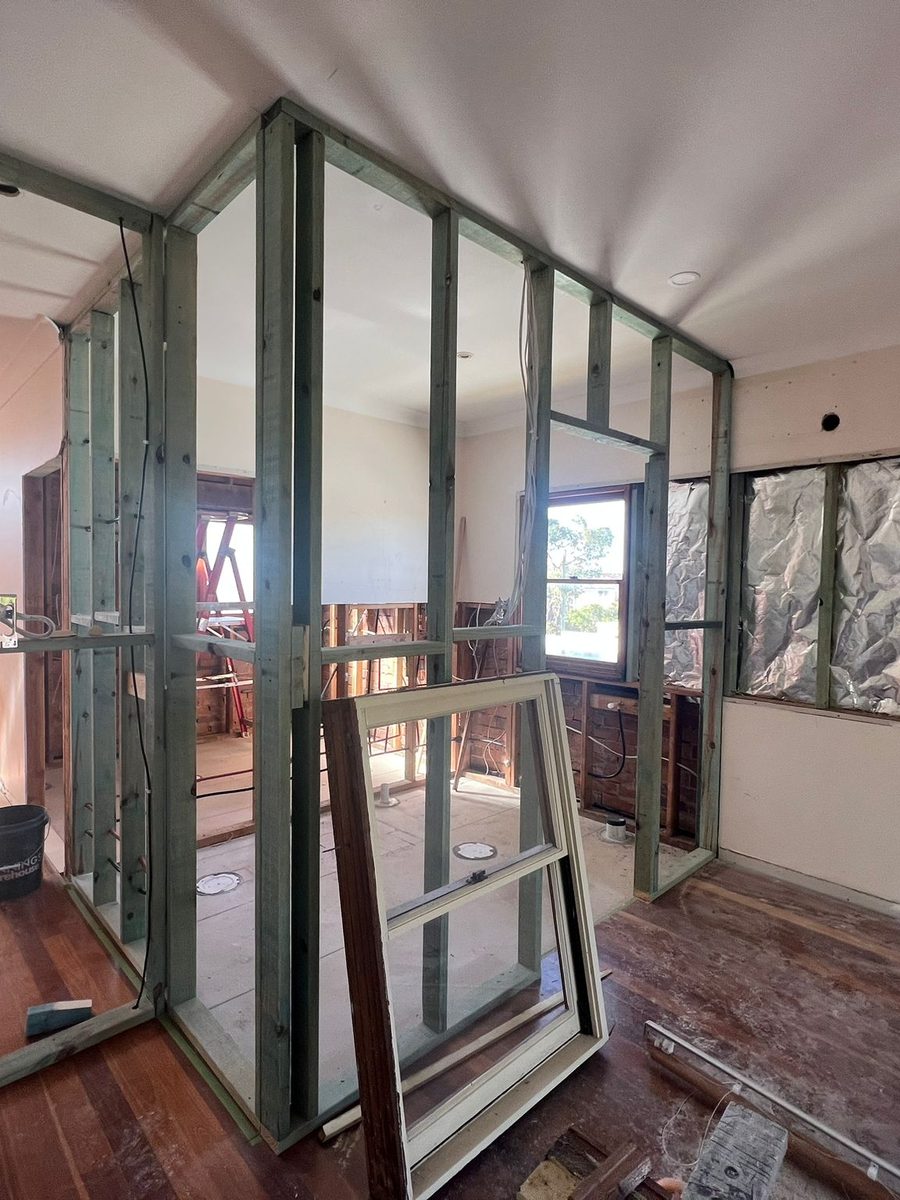
Walls out, rooms added, decks closed in. Lining and setting planned around the other trades so the junctions do not show.
Renovation work
Plastering Gyprock Ceilings
Sutherland Shire
The shire covers a lot of ground. A job at Cronulla and a job at Menai sit half an hour apart, and the housing at each end asks for genuinely different work.
Most of the Sutherland Shire went up between the early 1960s and the late 1980s: brick walls, a tiled roof, and a flat plasterboard ceiling screwed or nailed to timber battens. Gymea, Jannali, Sutherland, Miranda and Caringbah are full of it. Sixty years on, those ceilings are at the age where fixings start letting go and joints start to read under the light.
The rest of the shire behaves differently. Cronulla and Caringbah carry three-storey walk-up blocks alongside newer apartments near Miranda and Kirrawee stations, while houses along the Port Hacking foreshore have usually been extended or built over at least once. Same council, three different conversations.
Priced for the drive
The shire is wide. Travel and the number of visits are worked into the quote rather than turning up in it later.
Licensed contractor
NSW contractor licence 244708C, with the documents a strata manager or builder asks for supplied on request.
Built up in coats
Compound has to dry before the next coat goes on. A deeper repair means more visits, not one thicker fill.
Room handed back clean
Floors and furniture protected, sanding dust contained, and the space swept at the end of every visit.
The area
The stock
Four building types account for most of what we are asked to look at here. Which one you are in tells you more than the size of the damage does.
Single storey, flat ceilings on timber battens, cornice in every room, walls of set plasterboard or solid plaster over brick. Gymea, Jannali, Sutherland and Kirrawee are largely this. The common faults at this age are screw pops, joint lines and old patches sitting slightly off the plane.
Bigger rooms and longer ceiling spans around Menai and Illawong, often with a raked ceiling over the living area. Longer spans mean seasonal movement shows along a joint before it shows anywhere else.
Cronulla and Caringbah have plenty of brick walk-ups with no lift. Everything gets carried, sheet often gets cut down to make the stairwell, and more joints means more coats and more drying windows.
Caringbah South, Sylvania and Gymea Bay are full of houses that have been added to. Every addition leaves a junction where new lining meets old, and those junctions are where cracking settles in.
Foreshore work
A large share of the work along the Port Hacking side comes from something being built over, closed in or opened up. The plastering is ordinary. Working out what the new lining fixes to is the part that needs looking at.
A deck that gets closed in becomes a room, and a room needs a lined ceiling, lined walls and a junction with whatever it was attached to. The ceiling is usually the question: if the deck roof was never built to carry a lining, battens or a frame have to go in first.
Where a wall between two rooms comes out, the ceiling plane on both sides has to be joined and the cornice run made continuous. That detail decides whether an opened-up living area reads as original or as converted, and it is worth settling before demolition.
How it runs
Setting is a series of thin coats with drying time in between. That is what decides the calendar, not how many hours the work takes.
Pictures of each wall and ceiling, plus a note of what is being changed. From that we can usually give a realistic price and say where the job sits in the build order.
On site we look at framing, batten spacing, fixings, and whether anything above or outside explains existing cracking. If the answer belongs to a builder, a roofer or a plumber, you hear it before we quote.
Board goes up to the frame with the joins landing where they should, not where the offcuts fall. Sheet layout decides how much taping a room needs and how flat the finished plane can be.
Joints reinforced, fixings spotted, then built up in coats with proper drying between them. On a whole-room job that is usually three visits across a week or so.
Sanded back and checked with a light held flat along the surface, then the dust cleaned up and the room handed over paint ready.
Before we start On site
Pricing
Damage size is only part of it. These are the things that genuinely change the number here.
Menai, Illawong and Heathcote are a real drive from Cronulla. A job needing three visits is priced with those trips in it.
A ground floor room you can back a van up to is one job. A third floor flat with no lift is another, because everything gets carried and sheet gets cut down.
Plasterboard, solid plaster over brick and older fibro-era sheet behave differently once you cut into them, and they are not repaired the same way.
A flat 2.4 metre ceiling is straightforward. A raked living room ceiling in an 1980s Menai house needs staging and more setting-out time.
If there is still water getting in or the frame is still moving, the surface gets repaired twice. That gets sorted first or the money is wasted.
An empty house between owners runs efficiently. A family living in it, or a tenanted unit, gets staged room by room and cleaned down daily.
Sort this first
Most of what we see here is ordinary plaster work. A smaller group of faults is a symptom of something else, and plastering over those costs you the job twice.
Start here
Each one explains the work, how it gets scoped and what changes the price.
Walls out, rooms added, decks closed in. Lining and setting planned around the other trades so the junctions do not show.
Renovation workThe everyday faults a sixty year old brick-and-tile ceiling develops: joint lines, screw pops and old repairs off the plane.
Ceiling repairsA whole wall or ceiling brought back to one plane when it has been patched past the point of chasing individual marks.
Skim coatingDamaged runs repaired, joins made continuous where a wall has come out, and profiles matched to the rest of the house.
Cornice workShire questions
Six questions this council's housing raises again and again.
All of it, from the Sylvania side through Miranda and Caringbah down to Cronulla, and out to Menai, Illawong, Engadine and Heathcote. The postcodes run from 2224 through to 2234.
Distance changes scheduling rather than coverage. A repair needing three drying windows means three trips, so at the western and southern ends we group visits and give you dates that make sense.
Often yes, and the reason is drying time rather than plaster. If four rooms each need two or three coats, doing them in one run shares the set-up, the protection and the sanding day instead of repeating all of it four times.
Consistency is the other reason. Ceilings repaired years apart rarely read as one house. If several rooms have the same joint cracking and screw pops, treating the lot is better value.
First, what the lining fixes to. A deck roof built as a roof often has nothing suitable to screw a ceiling to, so battens or a frame go in before any board. The junction with the existing house has to be detailed so it does not crack along the join.
Once it is framed the plastering is ordinary: sheet, tape, coat, dry, coat, sand. That work sits on the renovation plastering page, and partition walls and framing covers any new internal wall.
For the plaster itself, not much. Compound and plasterboard in a dry, ventilated room behave the same at Cronulla as they do at Sutherland. What changes is how often a moisture problem turns into a plaster problem.
Salt air, wind-driven rain and unventilated bathrooms in older flats mean water finds its way in more often. Stop the water, let the space dry, then reinstate. Water-damaged ceilings covers that.
Yes, and it is common work here. Three storeys with a turn at each landing is the usual shape. Sheet gets cut down so it can make the stairs, which means more joints and another drying window, and that is in the quote rather than added later.
If the building has a strata manager, ask them early what they need. Licence and insurance details go across on request, and access approvals often take a week. Strata and property maintenance explains how that work gets scoped.
Give yourself more time than the plastering alone needs. A room of patching is commonly two or three short visits across four to seven days, and the painter needs their own days after us.
A fortnight of clear air before the shoot is comfortable for one or two rooms. If the whole house is being freshened, talk to us before the painter is booked.
Shire quotes
A photo of the damage, the suburb and whether it is a house or a unit is usually enough for a realistic price and a realistic set of dates.