
Ceiling replacement
The old ceiling comes out to the joists and a new one goes back, with the cornice reinstated.
Replacement
Plastering Gyprock Ceilings
Textured ceilings
Sprayed, stippled and popcorn ceiling coatings are common in older Sydney homes and units. What happens to one is decided by a test result, not by a scraper.
A sprayed textured ceiling is a coating, not a ceiling. Underneath it there is usually ordinary plasterboard or a set ceiling, and the coating was blown or trowelled on over the top to hide joints, soften sound and follow the fashion of the time. Most of them are still doing their job, which is why plenty of them are better left alone.
The part that matters more than any finish question is this: older sprayed ceiling coatings in Australia may contain asbestos, and that has to be settled by assessment before the ceiling is touched. This page explains what the coating is, what the assessment involves, and what the real options are once you know what you have.
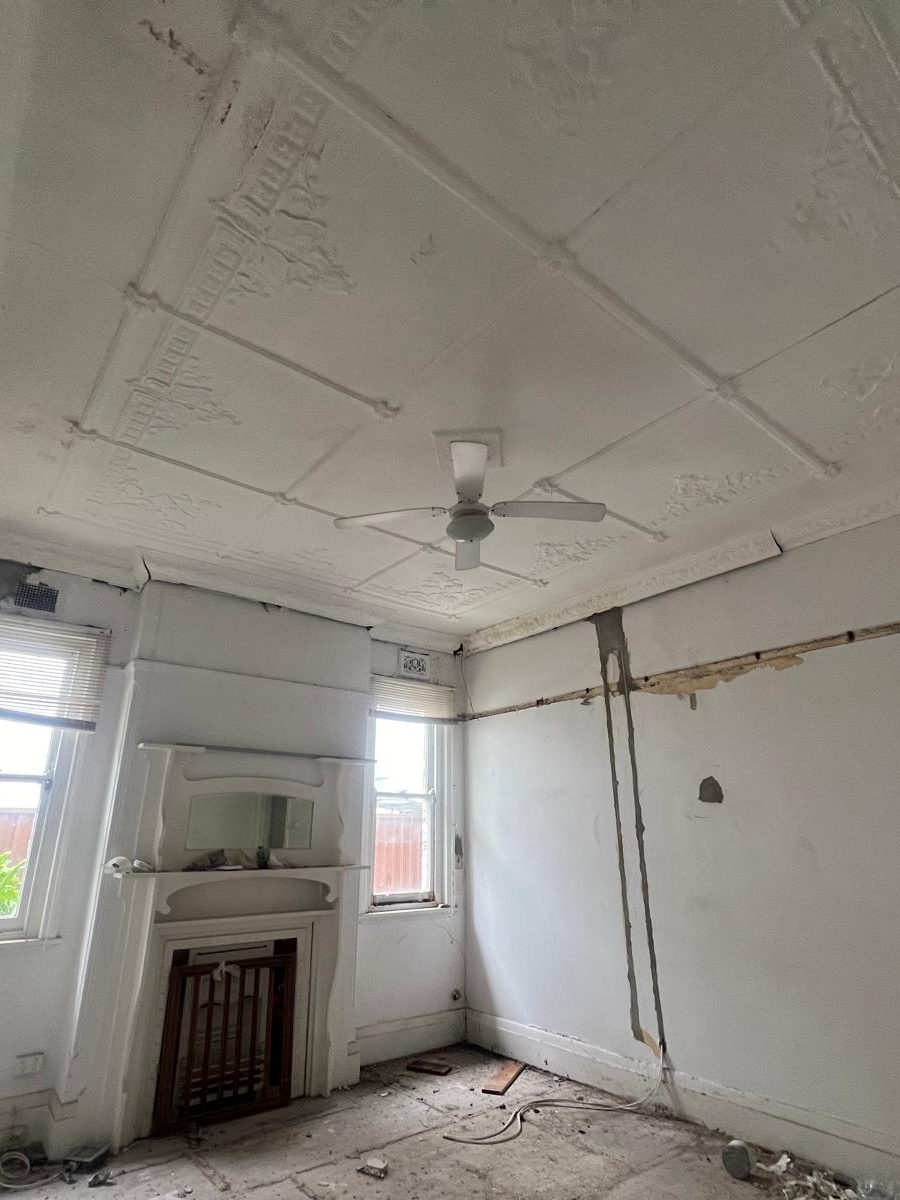
Nothing is disturbed first
No scraping, sanding, drilling or sampling by us. The coating gets identified before any decision is made.
Removal is licensed work
Asbestos removal is carried out by a licensed asbestos removalist. It is not something done here.
Leaving it alone is an option
A sound, undisturbed coating that is being managed is often the safest and cheapest answer.
We work after clearance
Once the ceiling is cleared or confirmed free of asbestos, the lining, setting and finishing is ours.
Sprayed, textured and popcorn ceiling coatings applied in Australia before the 1990s may contain asbestos. You cannot tell by looking at one, by its colour, or by how it feels. The only way to know is to have the material assessed by a competent person, with a sample analysed by an accredited laboratory, and a written result.
Until that has been done, the ceiling should not be scraped, sanded, drilled, cut, water blasted, pressure cleaned or had anything screwed into it. That includes putting up a light fitting, a fan, a curtain track or a smoke alarm, and it certainly includes a weekend attempt at taking the texture off. Disturbing the coating is what releases fibre. An undisturbed coating in good condition generally is not doing that.
If the material is found to contain asbestos, removing it is licensed work. Sprayed coatings of this type are generally friable, and friable asbestos removal in NSW must be carried out by a Class A licensed asbestos removalist, with the requirements set by SafeWork NSW, including air monitoring and a clearance before anyone else returns to the room. Plastering follows that clearance. Removal is not a service offered on this page or anywhere on this site.
What you actually have
None of this identifies a material and none of it replaces a test. It is here so you can describe what you are looking at when you ring somebody, and so you know which questions the assessment has to answer.
| What you can see | What it usually is | What it means for the next step |
|---|---|---|
| Coarse, lumpy, open texture like cottage cheese | A sprayed decorative coating, often called popcorn or vermiculite | Assessment first if the building or the coating predates the 1990s, or if the age is unknown |
| Fine stipple or a swirled, combed pattern | A trowelled or rolled texture coat over a set ceiling | Same answer. Age and history decide whether it is tested, not the pattern |
| Texture that has been painted over, several times | Often a later attempt to freshen it, sometimes to bind it down | Paint makes it harder to wet and harder to scrape, and changes nothing about testing |
| Staining, sagging or areas that have come away | Water has got into the coating or the board under it | Treat as damaged material. Keep the area clear and get it assessed rather than poked |
| Texture stopping at a neat line or in one room only | A partial renovation, so the building may hold more than one generation of material | Each area may need its own assessment. One clear result does not cover the whole house |
| Cracking through the texture along a straight line | Movement in the ceiling below the coating, not a coating problem | The cause is understood first. Any repair still depends on what the coating is |
Scope
This page covers sprayed, textured, popcorn and vermiculite ceiling coatings and what can be done about them. The division of work here is deliberate and it is not negotiable.
If a plasterer offers to scrape a textured ceiling off for you without asking what it is or when the building went up, that is the point to stop the conversation.
Where it stands
Why it is up there
Understanding why a textured ceiling exists makes the options easier to weigh, because most of the reasons it went on are reasons it is still doing something useful.
From the middle of last century through to the 1980s, spraying a textured coating over a ceiling was quick, cheap and forgiving. It covered joints and fixings without the labour of setting and sanding a ceiling flat, it took the edge off echo in a room, and for a long stretch it was simply what ceilings looked like in units, project homes and public buildings.
It also means the surface you are looking at is doing a covering job. Take it off and what is underneath is a ceiling that was never finished to be seen: joints that were never properly set, fixings that were never spotted, and often board that has been up a long time. That is why removing a texture is rarely just removing a texture. It usually turns into setting or re-lining the ceiling that is revealed.
The practical options are to leave it alone and manage it, to cover it, or to remove it and start again. Which of those is open to you depends first on the assessment, and second on the condition of what is underneath. If the answer turns out to be a new ceiling, that work is ceiling replacement, and a ceiling lined below the existing one is ceiling installation.
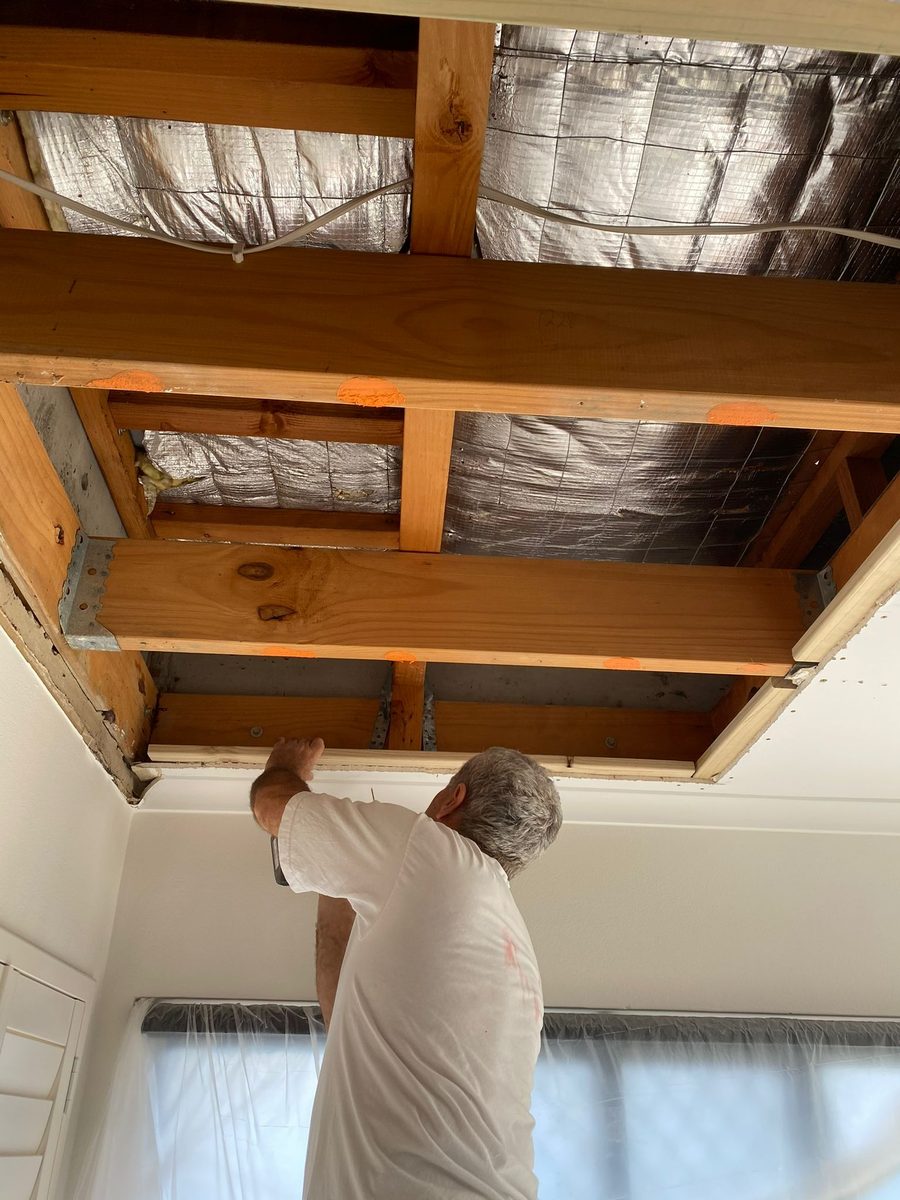
The order it has to happen in
This sequence is what keeps everyone safe and it is also what keeps the job honest. Nothing in the plastering trade happens until the first three steps are done.
Age of the building, any renovation history, and any asbestos register the property already has. In strata, the owners corporation is required to hold a register for common property, and it is worth asking for it.
A competent person, such as a licensed asbestos assessor or an occupational hygienist, takes the sample under controlled conditions and has it analysed by an accredited laboratory. You get a written result. This is the step that decides everything after it.
Manage it in place, cover it, or remove it. A sound coating that is not being disturbed is often best left and monitored. The decision belongs to you, with the assessment and the condition of the ceiling in front of you.
They set up the containment, do the removal, handle the waste and arrange the independent air monitoring and clearance that has to follow friable removal. We are not on site during that work.
Once the room has been cleared and handed back, our part begins: assessing what is left of the ceiling, lining it or setting it, running cornice back and finishing the room flat and ready for paint.
Joints taped and topped, fixings spotted, sanded and checked under raking light, then the room cleaned up. Where lights and fittings are coming back, the electrician follows us.
Assessment and clearance Lining and finishing
Where it usually goes
Once you know what the coating is, one of these is usually the work that actually gets done. Each one is priced on its own terms.
The old ceiling comes out to the joists and a new one goes back, with the cornice reinstated.
ReplacementA new lining fixed below what is there, battened and set to one flat plane.
New ceilingsBringing a sound, cleared ceiling back to a flat paintable surface without re-sheeting.
Skim coatingThe junction put back after a ceiling is re-lined, matched to the rest of the house.
CorniceBefore the quote
The assessment and any licensed removal are separate costs, quoted by the people who do that work. These are the things that move the plastering price once the ceiling is cleared.
Lining under the existing ceiling, re-sheeting after removal and skimming a sound surface are three different amounts of work, and they are not close to each other.
A ceiling that was set properly before it was sprayed needs far less than one where the coating was hiding unfinished joints and loose fixings.
Ceilings are priced by area, and a whole flat or a whole house is more efficient per square metre than one room done on its own.
Standard height rooms are straightforward. Stairwell voids, raked ceilings and high living areas need staging, and board has to be got into the room in the first place.
Whether the existing cornice survives, has to come off and go back, or has to be replaced, and whether it is a standard cove or something that has to be matched.
Downlights, fans, ducting, alarms and speakers all have to come out and go back, and that is electrical work sequenced either side of ours.
Work that has to fit around a removalist, a clearance and an electrician is staged. In a unit block, lift bookings and building hours shape the days.
An empty room is quick to set up. A furnished or tenanted home needs protection, staged rooms and a clean-up at the end of every visit.
Common questions
If yours is not here, ask it. We would rather answer it on the phone than have you guess.
You cannot know by looking, and neither can anyone else. Texture, colour, thickness and how it feels tell you nothing reliable. The only answer is a sample taken by a competent person, such as a licensed asbestos assessor or an occupational hygienist, analysed by an accredited laboratory, with a written result.
Until you have that result, treat the ceiling as though it might contain asbestos: do not scrape it, sand it, drill it, cut it or wash it down, and do not let another trade do any of those things either. That applies to a whole ceiling and to a single screw for a smoke alarm.
No. If the material contains asbestos, removal is licensed work. Sprayed coatings of this type are generally friable, and friable asbestos removal in NSW has to be done by a Class A licensed asbestos removalist working to SafeWork NSW requirements, with air monitoring by an independent licensed assessor and a clearance before anyone else goes back in.
Our work starts after that clearance. Where a ceiling has been tested and confirmed free of asbestos, removing a textured coating is ordinary messy plastering work and can be quoted normally. The point is that the order never changes: result first, then decide, then work.
Often, yes, and it is frequently the sensible answer. Material that contains asbestos and is in sound condition, sealed by paint and not being disturbed, is generally managed in place rather than removed. Removal creates the disturbance that the guidance is concerned about, and it costs a great deal more.
What changes that is condition and plans. A coating that is damaged, crumbling, water affected or in the way of work you are about to do needs a decision. So does a renovation where trades will be cutting into the ceiling. If you are managing it in place, the practical rule is simple: do not disturb it, and check on it.
It is a common approach and in the right circumstances it avoids disturbing the existing surface. It is not a way of skipping the assessment, because fixing a new lining means screwing through or near the coating, or fixing battens to the frame, and that is disturbance. It has to be assessed and planned on the basis of the result.
There are practical costs as well. You lose some ceiling height, every light, fan, vent and alarm has to be dropped and refitted, and the cornice has to come off and go back. Where those things work out, the finished result is a new flat ceiling and the old surface stays where it is. That work is ceiling installation.
Usually a ceiling that was never meant to be seen. The coating was often sprayed on precisely because it covered joints that had only been rough set, fixings that were never spotted and board that was never sanded. Sometimes there is a properly finished ceiling under it, but it is not the way to bet.
That is why a texture removal quote should always include what happens next. Expect the ceiling to need a full set or a skim afterwards, and in older or damaged board, expect re-sheeting to be on the table. Anyone quoting the scrape without the finish is quoting half a job.
Yes, in useful ways. In a strata scheme the owners corporation has duties around asbestos in common property, including keeping a register where asbestos is present or presumed. Asking for that register is often the fastest way to find out what is already known about the building.
It also changes the logistics. Work that affects common property, structural elements or the ceiling slab usually needs approval from the owners corporation, and building access hours, lift bookings and notification to neighbours all shape the programme. It is worth sorting that before any dates are set.
Not for its own sake. Plenty of textured ceilings are sound, undisturbed and perfectly serviceable. If yours is in good condition, is not damaged and you are happy with it, managing it in place is a legitimate choice and usually the cheapest one.
The reasons people do act on them are practical: the ceiling is damaged, the room is being renovated, the finish looks dated, or work is planned that will disturb the surface anyway. If one of those applies, start with the assessment and let the result shape what follows.
The approximate age of the building, whether the ceiling has been renovated, photographs taken from a distance rather than up close, and any documentation you already hold: an asbestos register, a previous test result, or a clearance certificate from earlier work.
If you already have a written result saying the coating does not contain asbestos, say so up front, because that changes the conversation immediately. If you do not have one, that is the first thing to arrange, and we would rather talk you through it than quote something that should not be touched yet.
Start with the result
Send photographs from a distance, the rough age of the building and any test result or register you hold. If the coating has not been assessed, that comes first, and we will tell you plainly rather than quote around it.