
Skim coating
For a wall that is sound but no longer flat. Tile scars, stripped wallpaper or a surface carrying too many old patches to blend into.
Skim coating
Plastering Gyprock Ceilings
Wall repairs
Doorknob holes, furniture dents, cracked corners, damage where a bracket or a shelf came off, and joins that have lifted. Cut back to something solid, then set flat and sanded.
A wall repair is judged from an angle, not from straight on. Almost anyone can fill a hole so it looks fine standing a metre away with the light behind them. The test is what the wall does when afternoon light runs down it, or when a lamp sits near it at night, and that is decided by how wide the repair is feathered rather than how neatly it is filled.
The other half of it is knowing what the wall is made of. Plasterboard, hardwall plaster over brick and old lath all fail differently and none of them take the same repair. So we work out what we are patching into before anything gets cut.
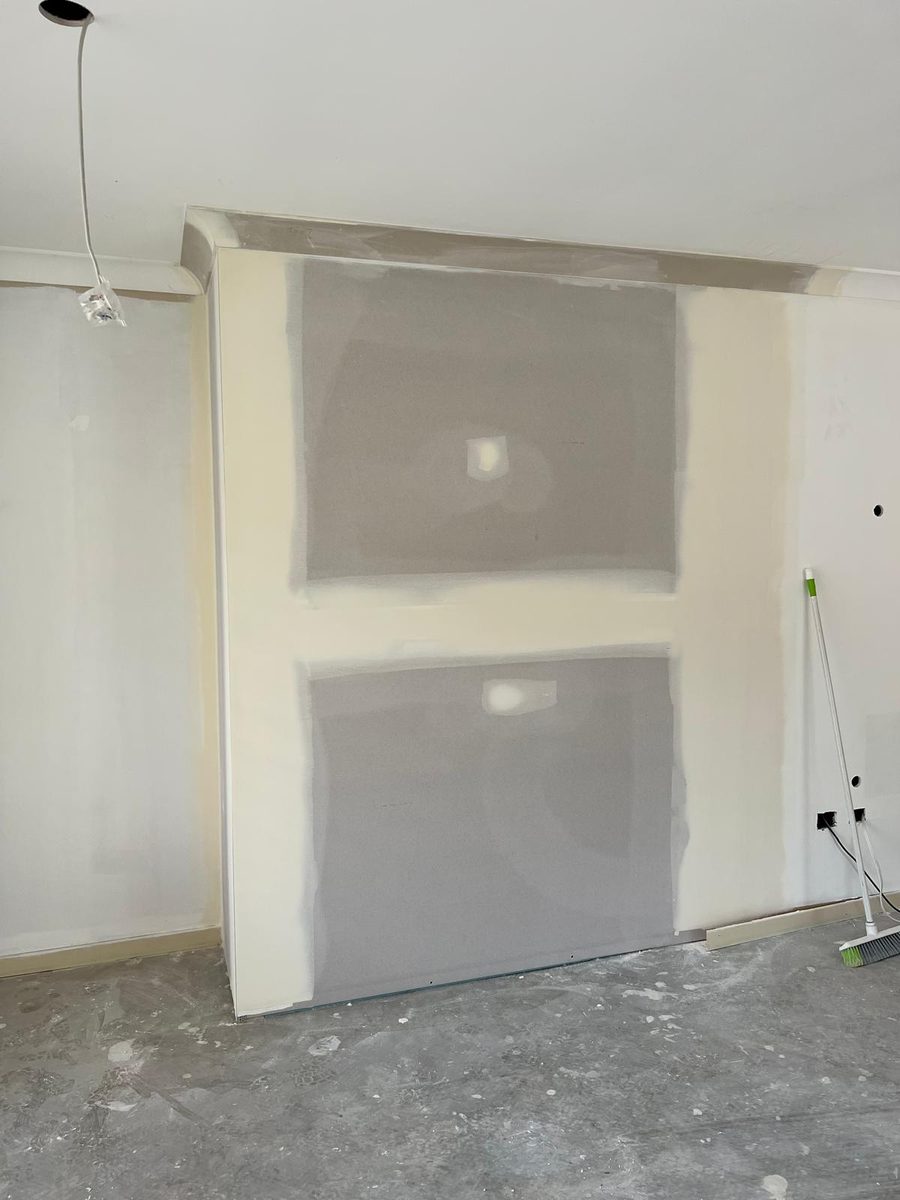
We match the wall you have
Plasterboard, hardwall over brick or old lath. What the wall is built from changes the repair completely.
Backing before filling
Anything bigger than a fist needs something behind it. A patch bridging fresh air cracks out the first time the wall gets knocked.
Feathered, not just filled
A repair shows because its edge is too tight, not because the fill is bad. Wide and flat beats neat and small.
Straight about resurfacing
If a wall has enough separate damage that patching will always read, we will say a full skim is the better spend.
What we get called for
Six jobs make up most of the wall repair work in Sydney houses and units. They are worth telling apart because two of them are half an hour and two of them are a two-visit job with drying in between.
Wall plugs, toggle bolts and the four bruised holes left by a television bracket. Small, but the plug usually has to come out properly rather than be pushed in, or the patch sits over a void and cracks.
A neat round hole with the paper torn back around it and often a crushed area you cannot see from the front. It needs backing behind the sheet before anything is filled, which is why a tube of filler never holds.
A bed frame, a vacuum, a trolley or a pram against an external corner. The metal angle bead under the plaster has usually been dented or lifted, and the bead has to be dealt with before the corner can be re-run straight.
Short diagonal cracks off the top corner of an opening, where the wall lining is doing the moving for the whole frame. Repairable, though the reason it opened decides whether it stays closed.
A line of lifted paper tape, or a hollow strip you can push in along a join. The tape lost its bond, usually because it went on over dust or too little compound. It gets cut out and re-taped rather than filled over.
Tiles taken off a plasterboard wall usually take the face paper with them, and stripped wallpaper can leave a wall that is sound but no longer flat. That is resurfacing, which is skim coating, not patching.
Behind the repair
Filler is not a structural material. Every repair below is really about giving the new plaster something solid to sit on and bond to, which is the part you never see once it is painted.
| Size and type of damage | The problem with filling it | What is actually done |
|---|---|---|
| Screw, nail and anchor holes | A wall plug left in place pushes the fill proud, and a loose one leaves a void behind it | Plug removed or driven back, hole cleaned out, filled in two passes and sanded flush |
| A hole up to about a fist | There is nothing behind the sheet, so fill spans a gap and cracks when the wall flexes | A backing piece fitted behind the board, then the patch built up over it in coats |
| A hole larger than a hand, or several close together | Patching over that much void will always read as a shadow, whatever it is filled with | Cut back to a square opening on the studs, new board fixed in, joins taped and set |
| A dented or lifted external corner | There is metal angle bead under the plaster, and fill over a bent bead cracks along the corner | Bead cut out or refixed straight, then the corner re-run in coats and sanded to a clean line |
| A lifted or blistered join | Filling over tape that has lost its bond traps the failure under the repair | The failed tape is cut out back to sound compound, re-taped and re-set wider than the original |
| Cracks in hardwall plaster over brick | The crack runs in the plaster coat, and a surface fill sits in a groove that keeps opening | Raked out to a wider key, reinforced where needed, then filled and finished in coats |
| Damage after a wall-mounted heater or handrail | Several fixings, often into studs, with crushed board between them | Fixings removed, crushed board cut out, backed and pieced in so the surface is continuous again |
Scope
This page owns repairs to walls that already exist: holes, impact damage, non-structural cracking, failed joins and the mess left behind when something came off the wall. New walls and whole-wall resurfacing are separate work.
If several rooms need the same work, say so at the quote. Ten holes across a house priced as one visit is very different from ten separate call-outs.
Know the wall
Sydney housing stock covers about a century of wall construction, and the four types below all get described on the phone as a plaster wall. Tapping it with a knuckle tells you more than looking at it does.
The quote
The number is rarely about the size of the hole. It is about how many separate places have to be protected, cut, built up and sanded, and how many visits that takes.
Four holes in one room is close to one job. Four holes in four rooms is four lots of setting up, protecting, sanding and cleaning.
A hole small enough to fill in two passes is quick. Once the sheet has to be cut back and something fitted behind it, the repair is a different task.
A patch in plasterboard is predictable. A repair in hardwall over brick, or in lath, takes longer and takes more judgement about how far to cut back.
Depth means build-up, and each coat has to dry before the next. That usually turns a repair into two short visits rather than one longer one.
A flat area in the middle of a wall is the easy case. External corners, window reveals, skirting lines and the junction under a cornice are all slower and less forgiving.
On a wall that already waves, a patch has to be blended into a surface that is not true. Sometimes the sensible answer is to skim the whole wall instead.
A bare room is quick to protect. A furnished lounge, a tenanted unit or an office that keeps working changes how the work is staged and how dust is controlled.
Stairs, lifts, loading docks and permitted work hours make more difference in units and commercial buildings than most people expect.
How it runs
Same four moves whether it is one anchor hole or a metre of damaged lining. The only thing that changes is how many coats and therefore how many visits.
A photo of each spot plus a rough size, and a note of what the wall is if you know. That is usually enough for a price and for us to bring the right board and bead.
Floors and nearby furniture covered, then the damage cut back to firm edges. Loose fill, torn paper and crushed board come out. Nothing sound gets set over something that has already failed.
A backing piece behind a small hole, or new board cut to land on the studs for a larger one. Where an external corner is involved the angle bead is refixed or replaced straight before any plaster.
Joins taped, then built up with drying time between coats. This is where the width of the repair gets decided, because the last coat has to run well past the damage for the wall to read flat.
Sanded and checked by eye and by hand with the light running down the wall. Then the dust cleaned up and the surface left ready for the painter.
Cut back and back up Build up and finish
Fine cracking along a join, short diagonals off a door corner, and hairlines in hardwall are all normal wall behaviour and they repair well. What is worth stopping for is a crack that steps down a wall in a staircase pattern, one that is wider at one end than the other, one you can see daylight or brickwork through, or one that runs through the mortar outside as well.
Add to that list any crack that opens again within a season of being repaired, and any that arrives at the same time as doors or windows starting to bind. Those are questions for a builder or an engineer. We would rather tell you that at the quote than take your money twice for the same crack.
Nearby work
Four pages pick up where patching stops. Each one is a different scope rather than a bigger version of the same job.
For a wall that is sound but no longer flat. Tile scars, stripped wallpaper or a surface carrying too many old patches to blend into.
Skim coatingNew lining on new or bare framing, including board selection and the finish it is handed over at.
InstallationCracks, screw pops, failed old patches and access cuts overhead, where the assessment is a different one entirely.
Ceiling repairsWork orders, resident access, evidence photos and clear invoice scope for managed buildings and rental properties.
Strata workQuestions
Short answers, and a few honest ones about when a repair is not the right spend.
On a flat painted wall, yes, and that is the standard the job is done to. The work that makes it invisible is not the filling, it is the cutting back to something solid, the backing behind the sheet, and feathering the last coat well past the damage so there is no edge for light to catch.
The one thing that gives a repair away afterwards is paint. Fresh compound takes paint differently from a wall that has been coated for ten years, so even a perfect patch can show as a slightly different sheen. If the repair is anywhere obvious, plan on repainting the full wall from corner to corner.
Roughly, anything up to about the size of a hand can be backed and patched in place. Above that it is usually quicker and stronger to cut a square opening back to the studs and fit new board, because that gives every edge something to fix to.
The exception is a hole in an awkward spot, such as tight against a corner, behind a fixed cupboard, or where a stud sits right beside the damage. There, a smaller cut with a properly fitted backing piece is often the better answer than fighting a full sheet into a space it will not go.
Yes, and it is one of the more common jobs. What matters is what was behind the fixings. Bolts into studs leave clean holes in sound board, which is a simple repair. Toggles and anchors into hollow board usually crush an area around each fixing that has to come out before anything is filled.
Tell us what came off and roughly what it weighed. If something heavy is going back on the same wall, say so at the quote, because that changes what should go in behind the patch. Putting solid backing in while the wall is open is far cheaper than doing it later.
Removing tiles from plasterboard usually tears the face paper off with the adhesive, and a wall with no face paper left cannot be patched in the ordinary sense. Small areas can be cut out and replaced. Anything approaching a whole wall is either re-sheeted or resurfaced.
Resurfacing is the usual answer where the board is still firm, and it sits on skim coating rather than here. In a bathroom or laundry where new tiling or waterproofing is going back, the substrate matters and that work belongs with wet area linings.
A small one usually does not. Anchor holes and shallow dents can be filled, sanded and finished inside a single visit. Anything with depth to it needs more than one coat, each coat has to dry, and compound shrinks slightly as it goes off, so stacking them wet is what leaves a dished repair.
So the answer is driven by depth rather than by size. A wide shallow scuff is one visit. A doorknob hole with a backing piece behind it is usually two short ones a day or more apart, and we will tell you which at the quote.
Yes. Hardwall plaster over brick is common across a lot of Sydney and it repairs well, it just repairs differently. Cracks are raked out to give the new material a proper key instead of being smeared into a groove, and larger areas of loose plaster are taken back to the brick before being brought back up in coats.
The judgement is how far to cut back. Plaster that sounds hollow when tapped has lost its bond to the brickwork, and leaving it in place because it looks fine means the repair fails at its edge. If a whole wall sounds hollow, that is a full application and sits with internal solid plastering.
Often not, and that is worth saying plainly. Every separate repair sits at a very slightly different level, and past a certain number the wall reads as a series of soft shadows in raking light no matter how good each individual patch was.
At that point one skim across the whole wall gives you a better result for a similar spend, and it is one lot of protection, sanding and clean-up rather than several. We will tell you when we think you have reached that point rather than sell you patch number thirteen.
Send the photos
A photo of each spot and a rough size is usually enough for a price. If several rooms need work, list them together, because it is cheaper as one visit than as four.