

Georges River council
Georges River plasterers for brick-and-tile homes and new apartment stock
Two building cycles are running at once here: fifties and sixties houses being renovated rather than replaced, and apartment blocks going up along the main roads and around the stations.
Most of the detached housing through Penshurst, Mortdale, Peakhurst and Blakehurst was built in the same twenty-year stretch, which means the same things tend to be wrong with it. Hard plaster ceilings that have moved at the joints, cornice runs that were never matched after a nineties patch, and a rear extension lined in a different decade to the rest of the house.
Around Hurstville, Kogarah and Allawah the work is different again. Newer apartments are all plasterboard, so the problems are finish problems: joints reading under a downlight, damage from a move-in, or a whole unit needing a tidy before it is leased. Both are covered from the same quote.
- Renovation and new build
- Houses, units and townhouses
- Cornice matched to the room
We come in at the right point
Linings go on after the rough-in is signed off. Going early costs you the wall twice.
Old rooms and new rooms matched
An extension should not announce itself at the doorway. The cornice and the plane have to carry through.
One trade through to sanding
Framed, sheeted, set, sanded and cleaned up by the same people rather than three visits from three trades.
Straight about what it needs
If the sensible answer is skimming the whole ceiling rather than patching it again, you hear that first.
The area
Coverage across Georges River
- Council area
- Georges River Council, NSW
- Postcodes covered
- 2208, 2209, 2210, 2217, 2218, 2220, 2221, 2222, 2223
- Common work here
- Renovation linings, ceiling repairs, cornice matching, skim coating, new unit make-good
- Nearest covered areas
- Bayside, Canterbury-Bankstown, Sutherland Shire, Burwood
The usual renovation
What happens when a 1960s house gets opened up
The most common job in this council area is not damage at all. It is a house from the middle of last century having a wall taken out, a kitchen moved or a rear room added, and the plastering having to make the result read as one house.
Once a wall comes out, three things stop lining up. The ceiling has a scar where the wall met it, often with different plaster on either side. The cornice run stops dead at the old wall line. And the new framing sits at a slightly different plane to seventy-year-old brickwork that was never dead flat to begin with.
None of that is difficult, but it has to be planned rather than discovered. Packing the frame out so the new sheet lands on the same plane as the old wall is the part that decides whether the join is invisible. So is deciding early whether the room gets a matched cornice or a square set finish, because the two are set out differently from the first sheet.
Where the original ceiling is hard plaster and the new section is board, we will usually recommend skimming the whole plane rather than trying to hide the transition. It costs more on the day and less over the life of the room.
How it runs
Where the plastering sits in a renovation
Plastering is one of the last wet trades and the first thing anyone judges the job on. Getting the order right saves more money than anything else in the schedule.
- 01
Look at it before the frame closes
The best time to quote a renovation lining is while you can still see the framing. Stud spacing, packing, where the noggins sit and whether the ceiling is level all decide how much work the setting stage will be.
- 02
Wait for the rough-in
Electrical, plumbing and any air-conditioning have to be in and signed off before sheets go up. Insulation and wet area waterproofing sit in the same window. Sheeting over an unfinished rough-in means cutting it open again.
- 03
Sheet and fix
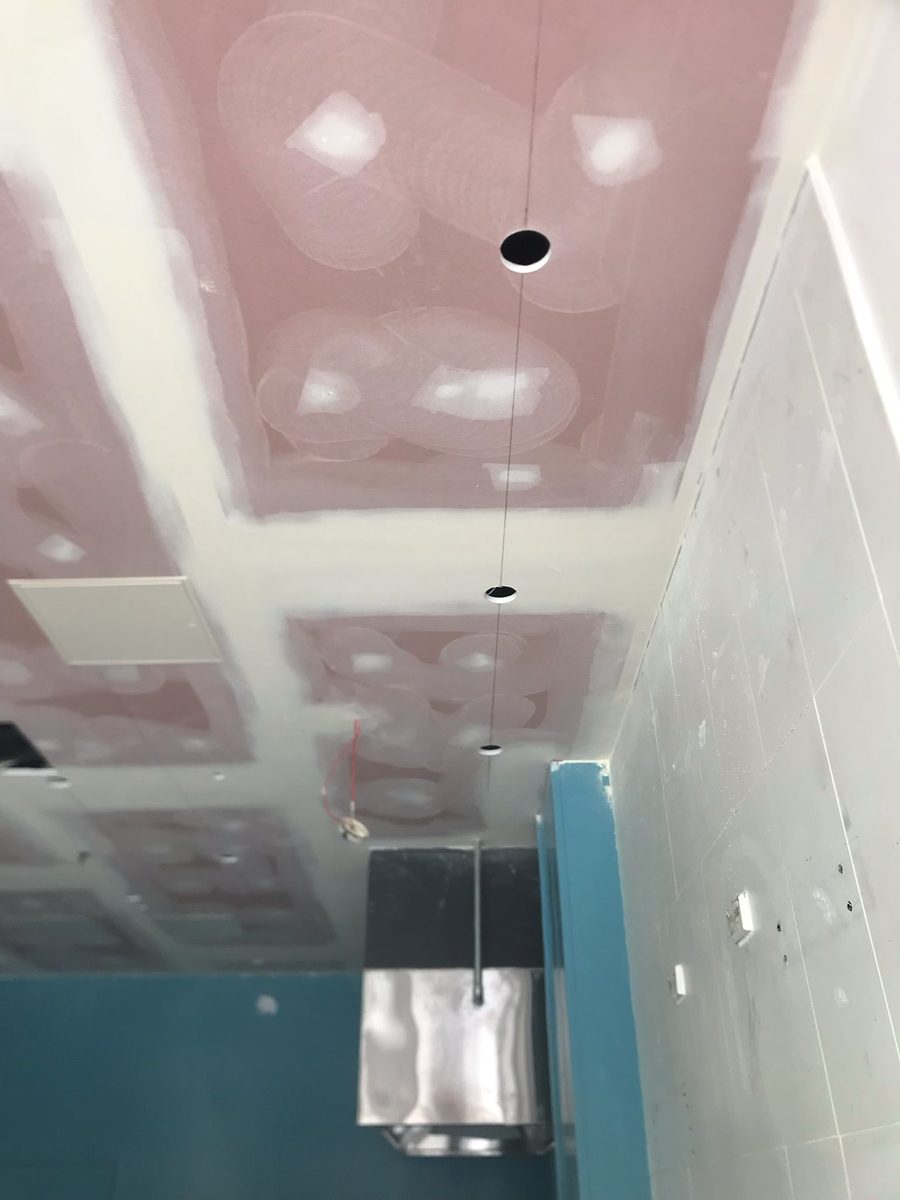
Ceilings first, then walls, so the wall sheets hold the ceiling edge. Sheet layout is chosen to put as few joints as possible where the light will rake across them.
- 04
Set in coats
Joints taped and built up over several coats with drying time between them. This is the part that cannot be compressed. A deeper build means another visit, not a longer day.
- 05
Sand, check and hand over
Sanded back, checked under a work light held flat against the surface, then cleaned up. The room goes to the painter flat, dust-free and ready.
Before sheeting Lining and finish
Matching it up
Old house, new work, and how the two are joined
Almost every renovation quote here comes down to one of these transitions.
| What you are joining | The problem it creates | The usual answer |
|---|---|---|
| New extension to original rooms | The two wall planes are a few millimetres apart at the doorway | Pack the new frame to the old plane before sheeting, then set the junction as one |
| New ceiling next to original hard plaster | Different surfaces catch light differently even when both are flat | Skim across both so the room reads as one ceiling |
| Cornice run cut by a removed wall | The profile stops mid-room with no clean end | Match the existing profile and carry it through, or change the whole room to square set |
| A garage or undercroft being lined | Masonry walls, a low slab and no existing lining to match | Frame out, line, and decide on a wet area board where moisture is likely |
| New unit with joints showing under lights | The joints are flat but not wide enough for the lighting | Widen and re-set the affected joints, or skim the plane if it is through the whole room |
What it costs
What drives a Georges River quote up or down
Area matters less than most people expect. What it is attached to matters more.
Whether the framing is ready
Straight, square framing at consistent centres sheets quickly. Twisted studs and an out-of-level ceiling are made straight at the lining stage, and that is time.
How much has to be matched
New work in a new room is simple. New work that has to disappear into a seventy-year-old room next to it is the expensive part.
Cornice choice
A standard cornice run is quick. Matching an older decorative profile so the join cannot be found, or setting out a shadowline, both take longer.
Ceiling height and stairs
Standard height off a platform is one rate. A raked ceiling, a stairwell void or a second storey with no easy sheet access is another.
Access for materials
A driveway and a clear side path is the easy case. A townhouse with a shared entry, or an apartment with a booked lift, changes the delivery plan.
Sequencing around other trades
If we can sheet, set and sand in one clean run the job is efficient. Returning three times around someone else's schedule is not.
How flat it has to read
A hallway with a single ceiling light is forgiving. A living room with recessed downlights washing along a wall shows everything, and is set to a higher standard.
Where to go next
Plastering services across the Georges River area
These are the pages people in this council area land on most. Each one explains what the work covers, how it is scoped and what affects the price.
- Renovation plastering for houses being opened up, extended or relined room by room
- Gyprock and plasterboard for new sheeting, setting and sanding
- Ceiling repairs for cracking along joints, screw pops and old patches that show
- Cornice for matching, replacing or carrying a profile through a changed room
- Skim coating to bring a patched wall or ceiling back to one flat plane
- Wall plastering and repairs for holes, impact damage and tired rooms
- Partition walls and framing where a room is being divided or a space under the house is lined
- New home and builder plastering for knockdown rebuilds and new dwellings
Other areas covered nearby
Georges River sits between the bay and the southern suburbs. These neighbouring areas are covered too, and all of them sit under our NSW coverage.
Neighbouring councils
Local questions
Renovation and apartment questions from this area
The five we are asked most often by owners and builders across Georges River.
We are renovating a 1960s brick-and-tile house. When should the plasterer come in?
Twice, ideally. Once early, to look at the framing and the existing rooms and price the job properly, and once to do the work after the rough-in has been signed off and the insulation and waterproofing are done.
The early look is worth more than it sounds. It is where we find the things that cost money later: a ceiling that is out of level, framing that needs packing, or an original cornice profile that will need matching rather than replacing.
Can you match the cornice in the rest of the house after a wall comes out?
Usually. Many profiles used through this area are still available or close enough that a matched run reads as original once it is painted. We would look at a section of the existing run before promising it.
Where the profile is unusual or the original is badly damaged, there are two honest options: carry a close match through and accept that a trained eye could find the join, or change the whole room to a clean square set or shadowline finish so there is nothing to match.
Our house is split-level near the river and we want the space underneath lined. What does that involve?
More than sheeting. An undercroft or lower level usually means masonry walls, a concrete slab and a lower ceiling, so the walls get framed out before anything is lined, and the framing decides the finished room size.
Moisture is the other question. A space cut into a slope can sit damper than the rest of the house, so the wall build-up and the board choice matter. Where a bathroom or laundry goes in down there it needs proper wet area linings, not standard sheet.
The apartment is nearly new but the walls look wavy under the lights. Can that be fixed?
Yes, and it is a finish issue rather than a fault in the building. Joints that are perfectly acceptable under a central light can read as a shadow once a downlight or a wall washer throws light along the surface.
The fix depends on how much of the wall is affected. A few joints can be widened and re-set. A whole room that reads unevenly is better skimmed, which puts a thin coat across the full plane so there is nothing for the light to catch.
Do you work for builders on new homes and knockdown rebuilds?
Yes. On a new build the lining stage is mostly about sequence and volume: getting on site when the rough-in is complete, sheeting ceilings before walls, and setting in coats with enough drying time that nothing shrinks back after handover.
What a builder usually wants to know is how the job is staged and what we need in place before we start. That is set out on the new home and builder plastering page.
Georges River quotes
Tell us what stage the job is at
Whether it is a crack in an existing ceiling or a house that is about to be opened up, the stage it is at changes what we need to see. Photos and a short description are enough to start.