
Strata plastering
Work orders, resident access, common-area protection and invoices scoped so a committee can read them.
Strata work
Plastering Gyprock Ceilings
North Sydney
A council area only a few kilometres across, carrying towers, 1960s walk-up blocks and Federation houses side by side. The plaster work changes with the building, and so does getting into it.
Most of the plastering we are asked about in North Sydney sits inside somebody else's building. A unit in Neutral Bay, a top-floor flat in Cremorne, a lobby ceiling in Milsons Point. The repair itself is often small. The lift booking, the loading dock hours and the question of who actually owns the wall take longer than the plaster.
Under the apartment belt there is still a base of older houses through Waverton, Cammeray and the streets behind Kirribilli. Those bring their own work: cornice runs, lath and plaster in the oldest of them, and ceilings that have been patched by four different people across a century.
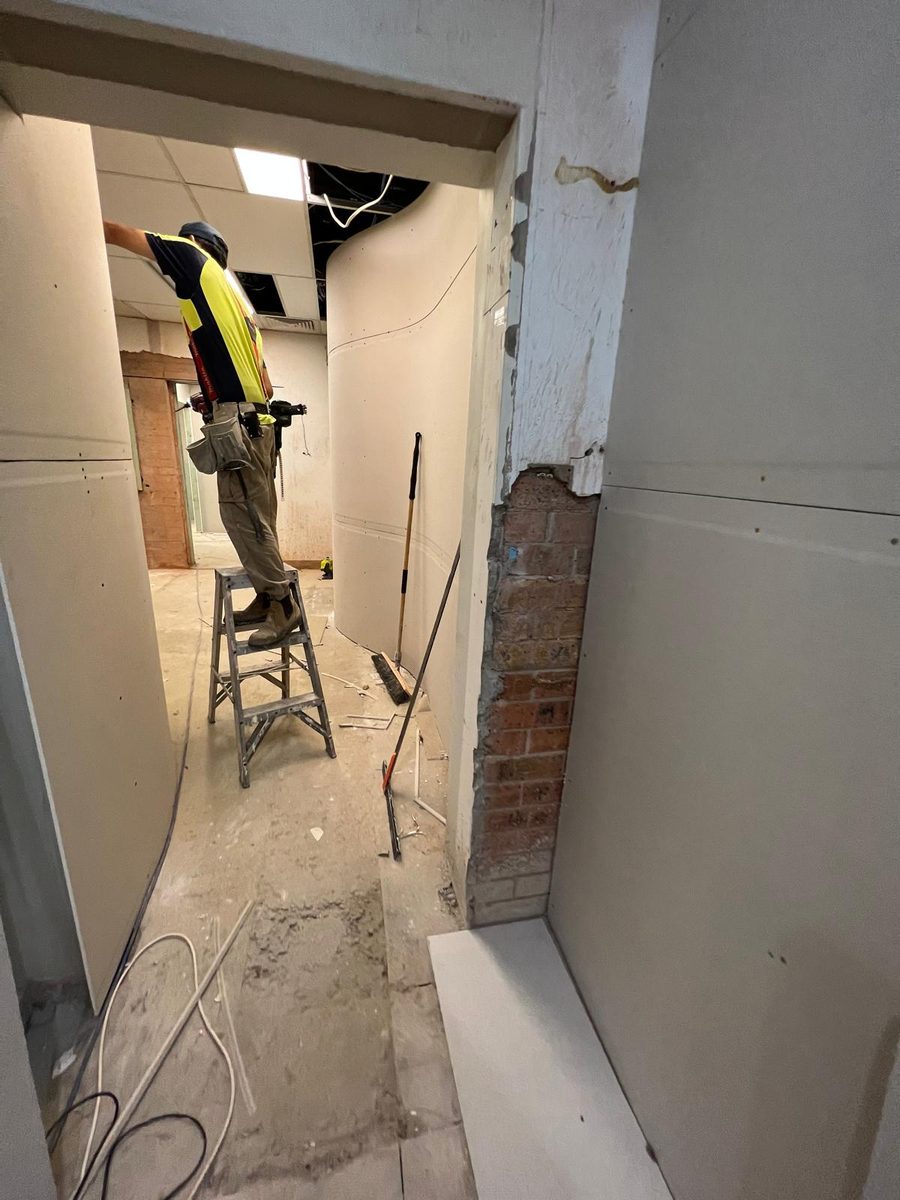
Built for building access
Lift bookings, dock windows and common-area protection get planned before the first sheet moves.
Small jobs taken seriously
A single unit ceiling is quoted and scheduled properly, not squeezed in between larger work.
Clear on lot versus common
We describe what we are repairing so you can work out who it sits with.
Licensed in NSW
Contractor licence 244708C.
Building types
North Sydney fits an unusual range of housing into a small area. Knowing which of these you are in tells you most of what the job will involve before anyone looks at the ceiling.
Three storey brick blocks through Neutral Bay and Cremorne. Concrete or timber-framed ceilings, hard-set walls in the older ones, and no lift, so everything is carried up the stairwell.
Set plasterboard on steel or timber battens over concrete. Repairs are usually straightforward, but access is governed by the building manager and the work hours in the by-laws.
Waverton, Cammeray and the older pockets. Decorative cornice, ceiling roses, and in the oldest of them lath and plaster still sitting behind a later coat.
Narrow houses split into flats, with partitions added at some point and junctions where the new lining meets original plaster that has moved since.
Corridors, lobbies, stairwells and car park soffits. Priced by area and by how much of the building has to keep working while it is done.
The commercial core through North Sydney, Crows Nest and St Leonards. Partitions, bulkheads and ceiling reinstatement between tenancies.
Access
This is the part that surprises people. In a freestanding house we park, unload and start. In an apartment building there are four or five gates to pass through first, and every one of them has a lead time.
What we get called for
Across a year the enquiries from this council cluster into a handful of repeating jobs. Here is what they usually turn out to be and where each one is dealt with.
| What gets described | What it usually is | Where it belongs |
|---|---|---|
| A stain on a unit ceiling | Water from the balcony or bathroom above, or a common-property pipe | Water-damaged ceilings, once the source is stopped |
| Cracking along the top of a wall | Slab and partition moving against each other, common in towers | Wall plastering and repairs |
| Holes after a bathroom renovation | Lining cut back for plumbing or waterproofing and never made good | Wet area linings |
| A corridor ceiling opened up | Fire or hydraulic services accessed through the plasterboard | Ceiling access panels |
| Cornice damaged in an older flat | Original run knocked, painted over repeatedly, or cut for a new service | Cornice |
| Walls that read as patchy under light | Decades of separate repairs at slightly different levels | Skim coating |
In a strata building the boundary between your lot and common property usually sits at the inner surface of the structure. A ceiling under a concrete slab, and the plasterboard fixed to it, will often be the owners corporation's problem rather than yours, particularly when the cause came from outside the lot.
We are plasterers, not strata managers, so we will not tell you who is liable. What we will do is describe in writing what failed and where, with photographs, so you can put it to the committee or your insurer before the repair goes ahead.
Before the quote
Two identical ceilings in two North Sydney buildings can be quoted very differently. Almost none of the difference is the plaster.
Ground floor with a dock is one job. Level fourteen with a booked lift and a long corridor walk is another, and the difference is time, not skill.
Metered and resident-only streets across most of the LGA. A permit, a loading zone or a spot in the building changes how many visits are practical.
If cutting and sanding can only happen inside a set window, the job stretches across more days even though the hours are the same.
An owner deciding on the spot moves quickly. A work order through a strata manager and committee has its own timeline and its own paperwork.
Set plasterboard in a recent tower behaves predictably. Hard plaster and lath in a pre-war flat needs a different approach and a cautious first cut.
Repairing one painted wall is simple. Matching an original cornice profile in an older block is slower.
Start here
Four pages cover the bulk of the work in this council area. Each explains what the job involves, how it is scoped and what affects the quote.
Work orders, resident access, common-area protection and invoices scoped so a committee can read them.
Strata workCracks, screw pops, failed old patches and access cuts, repaired and set back to one flat plane.
Ceiling repairsReinstatement after a leak from the unit above or a common-property pipe, once it has stopped and dried.
Water damageCeilings, partitions and bulkheads for the commercial floors around North Sydney, Crows Nest and St Leonards.
Fit-out workLocal questions
Most of these come from people living in or managing an apartment. If yours is not here, send a photo and ask.
Yes, and it is normal here. Tell us the permitted hours at the quote and we will plan the noisy stages, cutting, fixing and sanding, to sit inside them. Quiet work such as taping and coating can often run outside that window if the building allows it.
The practical effect is on the calendar rather than the price. A repair that would take one day in a house may run across two or three short visits in a building with a narrow work window.
For anything involving full sheets, trestles or waste removal, yes. Most buildings here want notice, a blanket fitted and a set time slot, and turning up without one usually means the load goes back on the truck.
For a small repair we can often carry what we need in by hand and avoid the booking entirely. We will tell you which it is when we see the photos, so you only involve the building manager when it is genuinely needed.
That depends on where the water came from and how your building's by-laws sit, which is a strata question rather than a plastering one. What matters for us is that the leak has been stopped and the space has dried before anyone reinstates the plaster.
We can document the failure with photographs and a written description of the affected area so it can go to the owners corporation or an insurer. Repairing over water that is still moving means paying for the same ceiling twice.
Often not. Many of the older walk-up blocks have hard plaster applied directly to brick, or a render and set finish, rather than plasterboard on battens. It sounds solid when you tap it and it does not cut the same way.
That changes the repair. Patching hard plaster is closer to solid plastering than to a plasterboard patch, and where a wall has been patched many times over the decades a skim coat across the whole surface often gives a better result than another local repair.
Single repairs are a large part of the work here, because that is what apartments generate. One patch, one access cut, one run of cornice. We will quote it as its own job.
What we would rather avoid is three separate visits to the same building in the same month for three separate small repairs. If you are a manager or an owner with a list, send the whole list. It is quicker and it prices better than three attendances.
No. We hand the work over sanded, cleaned up and ready for paint, and we will tell you how far the paint needs to go. That is usually further than people expect, because fresh compound and aged paint never match on the same plane.
For a wall repair, plan on repainting to the nearest internal corner. For a ceiling, plan on the full ceiling.
North Sydney
A picture of the damage, the floor level and whether there is a lift and a loading dock is usually enough for us to price it and tell you how many visits it will take.